With safety being a major requirement to obtain approval in major markets, Chery Automobile is forging ahead to ensure its vehicles are up to the mark.
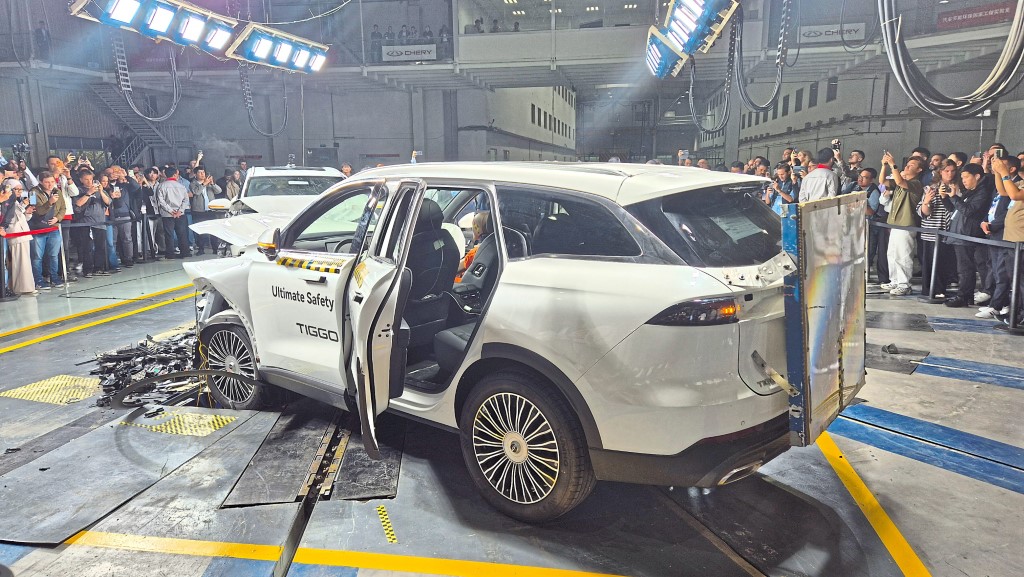
Chery Automobile showcased its commitment to safety via a live crash test demonstration involving its flagship sports utility vehicle (SUV) - the Tiggo 9 CSH plug-in hybrid electric vehicle (PHEV).
Held at the company’s dedicated crash lab at the Longshan Test Centre as part of the its Ultimate Safety Exploration Tour, the event featured two Tiggo 9 CSH that underwent a head-on collision before a crowd of invited guests, members of the media and company personnel.
With roughly 500 witnesses, the PHEVs were positioned at a 15-degree angle to each other with a speed of 50kph and the test is known as a Dual Car Frontal Offset Impact test.
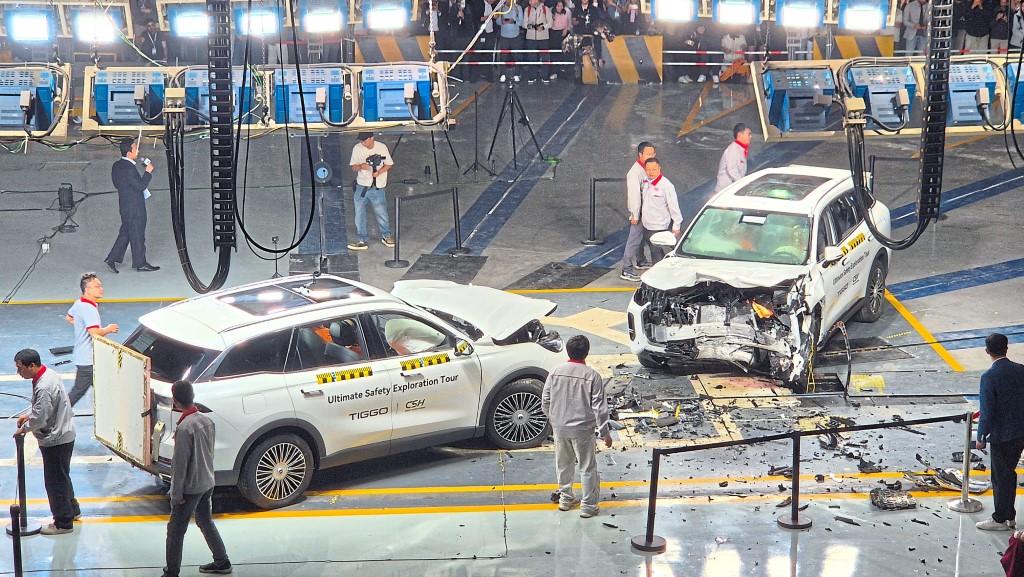
According to the company’s traffic accident data, the chosen impact angle was designed to replicate the most common type of collision, which accounts for 53.8% of all crashes.
In these incidents, about 20% of vehicles were found to be travelling at speeds between 41kph and 50kph at the moment of impact.
By crashing head-on into each other at 50kph, the test simulated a 100kph impact to demonstrate the structural performance of their A, B, C and D pillars, which remained undeformed,
This meant that the load-bearing structure of the cabin stayed intact, which acted as a key indicator of occupant protection and structural rigidity in crash safety engineering.
The D-pillar is the rearmost pillar that’s found on larger vehicles (SUVs, station wagons, and minivans), which supports the rear tailgate structure and frames the cargo area.
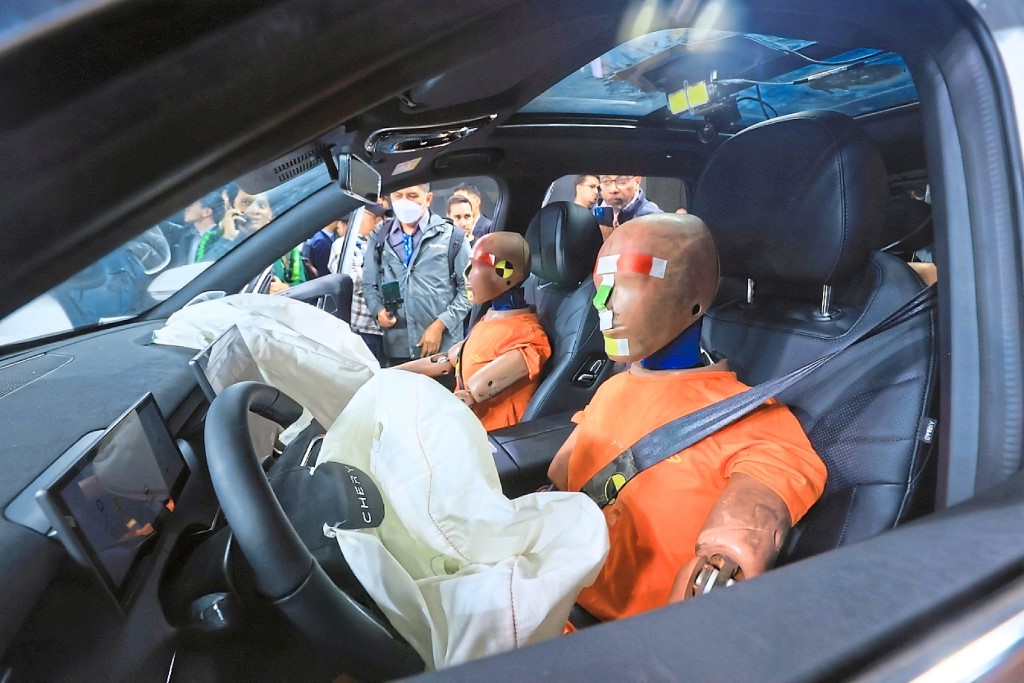
Furthermore, the restraint system (airbag deployment and seat belts) showed that it worked normally and no leakage was detected from each vehicle’s fuel systems.
Meanwhile, the hazard lights were automatically engaged to help prevent a secondary collision, and the locking mechanism of the doors worked to allow passengers to exit the vehicle or allow rescue services the ability to extricate them if needed.
Nonetheless, the live test demonstrated the vehicle’s structural integrity, which was led by Chery Automobile deputy general manager Gavin Liang and chief engineer Dr Xu Youzhong, who is also vice-dean of the Automotive Engineering Technology Research and Development Institute.
It should be noted that while the Tiggo 7 and 8 models managed to achieve a five-star rating in the latest European New Car Assessment Programme (Euro NCAP) tests, the Tiggo 9 had yet to undergo such tests at the time of writing.
Chery is said to follow a rigorous Safety Development Methodology that exceeds industry norms.
While Euro NCAP is considered to be one of the world’s most respected benchmarks for vehicle safety, something that many Malaysians also believe, the independent organisation uses a similar test.
Here, a deformable Mobile Barrier (Trolley) with a mass of 1.4 tonnes is accelerated up to 50kph as well, only the impact occurs at zero degrees, and covers 50% of the vehicle’s frontal width.
Additionally, out of 127 global test standards, the company is said to apply 67 - significantly more than the industry average of 45.
It also performs more than 200 physical crash tests annually and looks to maintain a 95% simulation accuracy during development.
In its entirety, the company incorporates more than 1,000 development and evaluation specifications, including 89 vehicle-level and 628 system-level safety requirements.
The carmaker is also said to push its testing limits further through its long-term plan, dubbed 2025 Safety Challenge Footprint.
The programme includes extreme real-world trials such as a spiral rollover challenge in China, underbody scratch testing in Mexico, seawater and desert durability tests in Qatar and Kuwait, and an upcoming rainforest challenge in Brazil.
These exercises are designed to replicate the most demanding driving environments on Earth.
The company’s safety philosophy, dubbed Full All Safety Technology, focuses on protection across all people, all processes, all scenarios, all directions and in all markets.
This all-round approach ensures that both passive and active safety systems work together seamlessly in every situation.
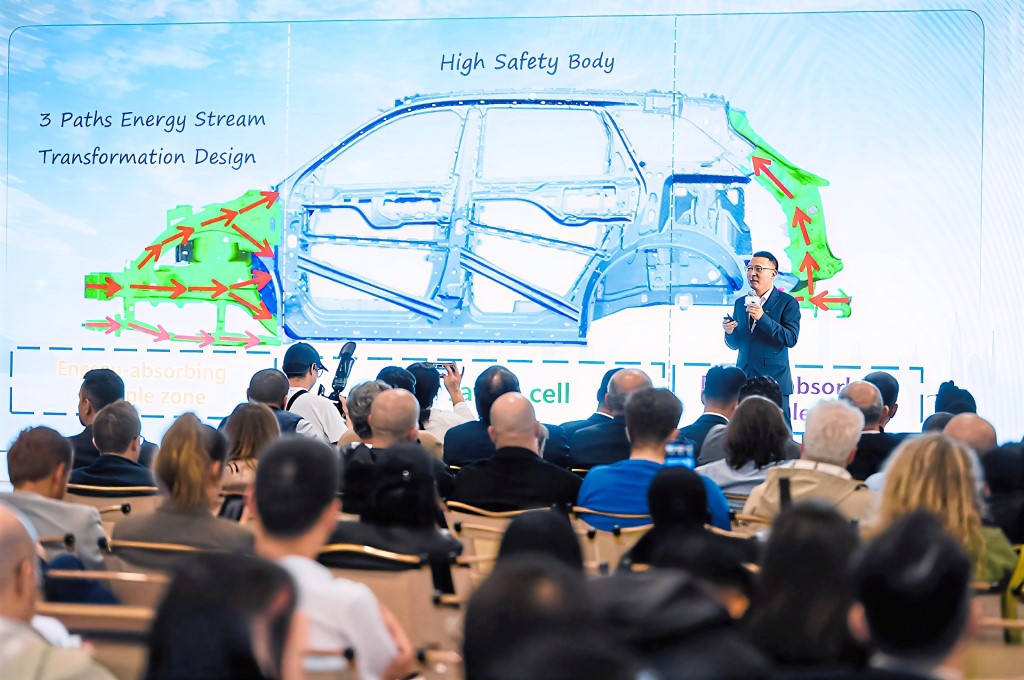
At the core of this philosophy is Chery’s advanced structural engineering, where each chassis is touted to be built with a balance of rigidity and flexibility by featuring 85% high-strength steel and 21% hot-formed steel.
The structure also integrates six crash boxes and 28 energy-absorption paths to distribute and manage impact forces - keeping the cabin stable and its occupants safe.
Backing these efforts is the company’s National Engineering Research Center, which serves as a hub for advanced testing and innovation by including a crash lab where live demonstrations take place — as well as dedicated facilities for NVH (noise, vibration, and harshness) testing, materials development, software verification, system reliability, vehicle dynamics, and energy management.
The centre also houses a mini test track and full-scale road test areas for performance validation in real-world conditions.
Through such demonstrations and global testing programmes, the company shows that its commitment to safety is an integral part of each vehicle that leaves the factory.