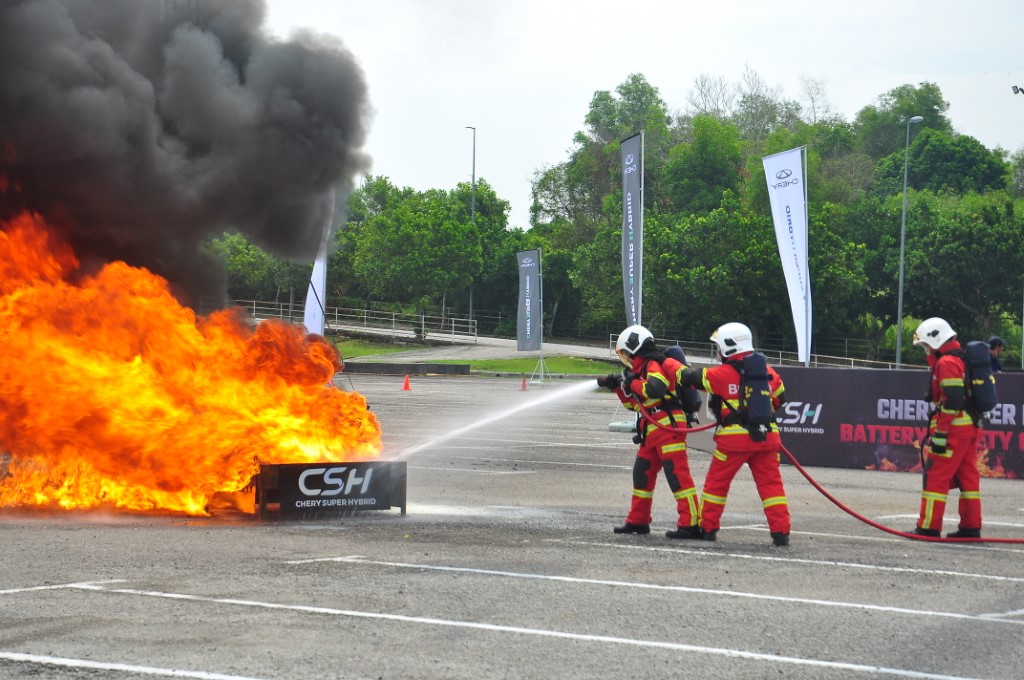
SERI KEMBANGAN: CHERY Malaysia, the official distributor of Chery vehicles in Malaysia, conducted a battery durability test to showcase the company's commitment to safety levels by exposing a plug-in hybrid electric vehicle (PHEV) battery to extreme heat.
Witnessed by about 100 attendees from government officials and members of the media at Malaysia Agro Exposition Park Serdang (MAEPS), the event — dubbed Chery Super Hybrid Battery Safety Challenge 2026, was to showcase that the carmaker's PHEV batteries have been engineered to withstand up to 800 degrees Celsius for 105 seconds.
However, the battery, which is used in the Tiggo 7 PHEV and Tiggo 8 PHEV, was observed to have withstood direct flame exposure exceeding such standards.
The peak amount of heat was measured at 1,100 degrees Celsius with an exposure time of 1 minute and 20 seconds — made possible by setting 35 litres of RON95 petrol alight.
In a controlled laboratory test, the standard has been set at 105 seconds (1 minute 45 seconds) at 800 degrees Celsius.
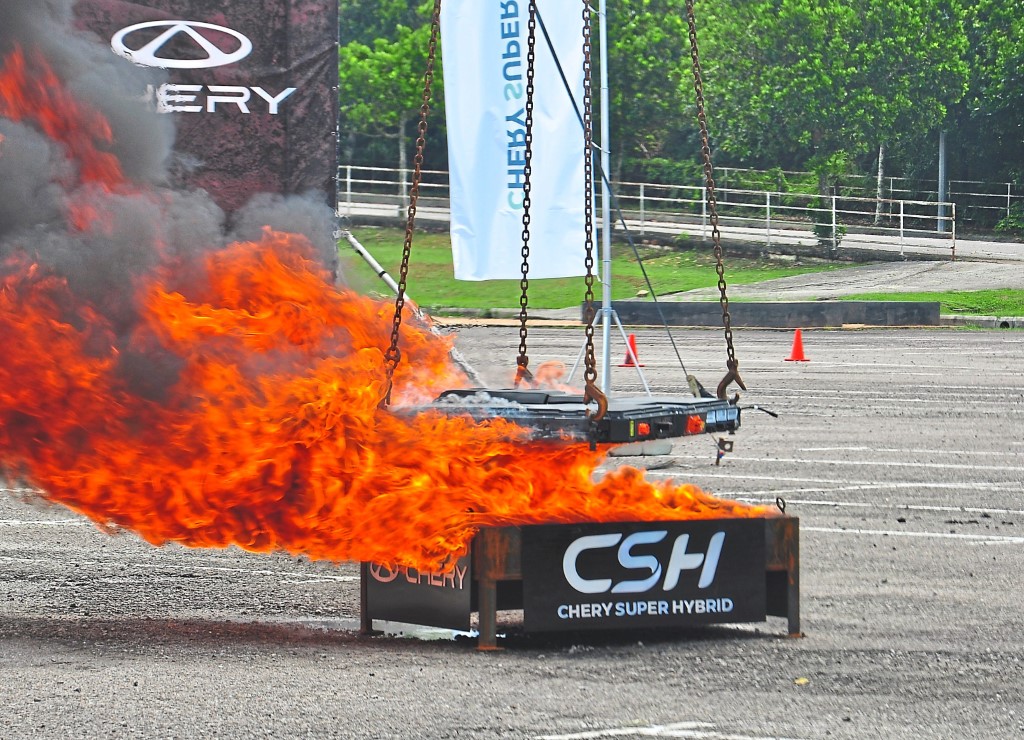
With the battery able to survive a more intense heat than it was intended for, it means that while a vehicle may have caught fire due to an accident, the battery managed to maintain its integrity for longer, so that conscious occupants have more than enough time to exit to safety.
The event in Malaysia builds on the company's global battery safety programme, under which the automotive brand has subjected its battery systems to a wide range of extreme and real-world scenarios across multiple markets.
Previously, the China-based carmaker conducted a series of safety challenges internationally, including a head-on collision and spiral rollover tests in China.
In Indonesia, the battery pack was immersed in seawater for 53 hours, testing its resistance to corrosion and electrical isolation in highly humid and saline conditions.
In South Africa, an offset frontal collision test at 50kph was organised to showcase its vehicle's protection against real-world crash scenarios.
In Ecuador, a multi-angle live-fire test was conducted with six rounds of 5.56-calibre bullet penetrating the battery pack to prove the battery's structural integrity under extreme and unconventional stress.
In the Middle East, Chery’s batteries were subjected to 60 degrees Celsius seawater immersion in Qatar for 48 hours, as well as burial beneath Kuwait’s scorching desert dunes for 48 hours to simulate the battery's performance under prolonged exposure to heat, humidity, and environmental conditions.
Meanwhile, in Mexico, Chery conducted a battery scraping test, assessing resistance to abrasion and underbody damage risks.
Chery Corporate Malaysia executive vice-president Men Lin Bo said safety is at the core of the brand's development process.
"Beyond meeting regulatory requirements, we conduct rigorous and extreme validation tests, and we demonstrate these tests publicly to help people understand the technology, the standards behind it, and why we are confident in its safety," he said.
Chery Malaysia vice-president Lee Wen Hsiang said the company's PHEV offering reflects a very complete and thoughtful approach to safety and ownership confidence.
Lee added that each element builds on a long-standing commitment to protecting customers — one that combines proven safety performance, dependable technology, and assurance throughout the ownership journey.