MUNICH: Tesla believes all-electric trucks are the key to a green road haulage future, while South Korea's Hyundai is backing the hydrogen fuel cell.
A new German company has come up with an attractive-sounding third option.
Instead of using hydrogen in a fuel cell, Munich-based Keyou has developed technologies that can convert conventional diesel engines to run on pure hydrogen.
CEO and founder Thomas Korn said such hydrogen-fuelled trucks boast a better range than fuel cell trucks, although hydrogen consumption is slightly higher.
"Our vehicles demonstrate that hydrogen engine technology also works practically and is a cost-effective and robust alternative to battery electric or fuel cell vehicles," said Korn.
The hydrogen-fuelled engines are as durable as regular diesels and straightforward to service, said Korn. They also use none of the scarce rare-earth metallic elements that are an essential part of many high-tech devices and battery-electrics.

Keyou (inset) says its hydrogen-fuelled engines are as durable as regular diesels and straightforward to service.
The company recently completed a €16 million (RM73mil) financing round and is working closely with a number of OEM manufacturers in the auto and truck industry.
Keyou said truck engines could be converted to run on hydrogen swiftly so that instead of belching black fumes, big articulated rigs and delivery trucks would soon emit just wisps of harmless water vapour.
One of the biggest hurdles along the way is the lack of re-fuelling infrastructure and a range of 500km between top-ups.
Germany has only a few hydrogen refuelling stations while France for example has hardly any.
The hydrogen fuel option proposed by Keyou is not new but it has become realistic again as the race to clean up road transport gathers pace.
Converted engines would run on hydrogen gas injected into the combustion chambers just like diesel fuel, instead of using a fuel cell to convert the hydrogen into electricity for traction
Carmaker BMW went down this road for some years and its hydrogen-powered 7 Series limousines were regular features at international car shows. Korn worked as an engineer on the programme.
One problem was the huge fuel tank in the boot which left little space for luggage. In 2009, BMW abandoned work on hydrogen-powered internal combustion engines, saying the technology had run its course.
The tank in the Hydrogen 7 chilled the gas to a liquid at -253 degrees, but the highly-inflammable gas was so unstable in the onboard storage that it evaporated from full to empty within three weeks.
For a few years, Berlin's BVG transit company operated 14 MAN buses which ran on hydrogen but they broke down frequently and the experiment was later abandoned.
Keyou has opted for compressing the hydrogen to 350 bar. By doing so, existing diesel engine designs can be easily adapted to run on the gas, provided certain components are beefed up to take the strain, the firm says.
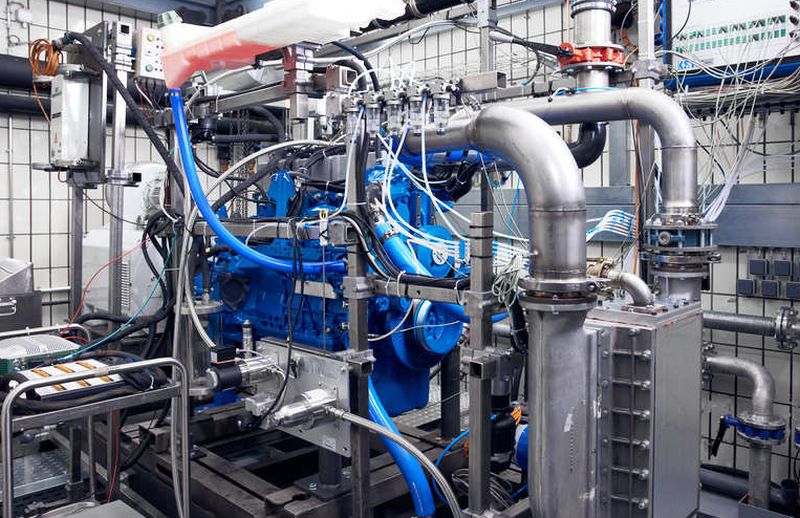
This means the technology is more suited to new engines being assembled on a production line rather than for retro-fitting second-hand units in existing trucks.
Lorries with hydrogen-driven engines are lighter than both electric and fuel cell trucks since there are no heavy batteries, while delivery delays caused by charging are also no longer an issue.
Tesla claims a range of 800km for its truck and the battery is said to have a capacity of one megawatt hour. On the down side, this means that, even when using a 350-kilowatt fast charger, it takes about three hours to fully recharge the lorry's battery.
Keyou has just unveiled prototypes of an 18-tonne truck based on a Daimler Actros underpinnings and a 12-metre urban city bus based on a Polish-built Solaris vehicle.
Both use diesel motors converted by Keyou to run on hydrogen and will go on display at the IAA Commercial vehicle show in Hanover this September. Test drives on public roads around Munich will take place beforehand.