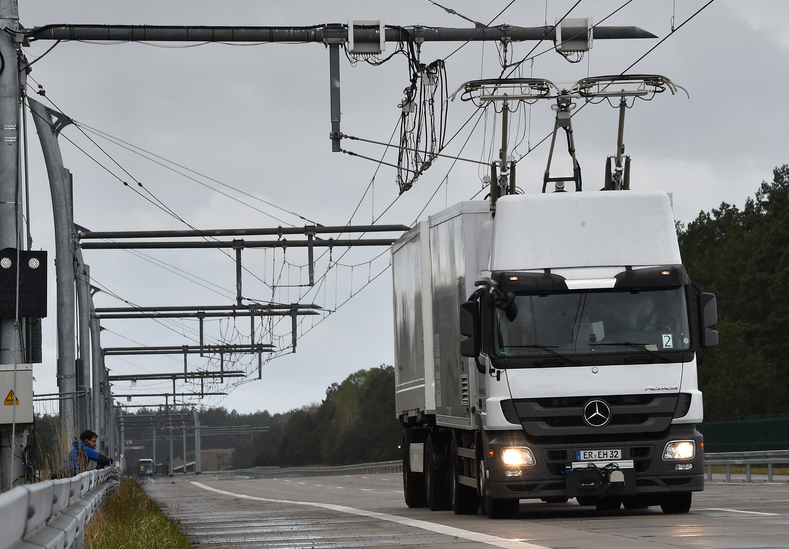
BERLIN: Sobering reports in Germany have cast doubts over viability of a multi-million-euro scheme that uses overhead wires on fast public roads to power long-distance trucks.
Pitched by the Berlin government as a major breakthrough in cutting diesel lorry emissions, results from several years of tests have proved disappointing, according to a report from broadcaster WDR.
The economic benefit is also unclear. A study by Germany's private-sector Institute for Applied Ecology and other researchers claims the trolleybus-style trucks will be more expensive to operate than diesel lorries for many years to come.
Tests of the so-called eHighways by Siemens are under way in Germany on three public highway routes.
The A5 motorway between Frankfurt and Darmstadt is one of the busiest roads in the country. There are 400 catenary masts along the carriageway, with overhead lines stretched across the right-hand lanes.
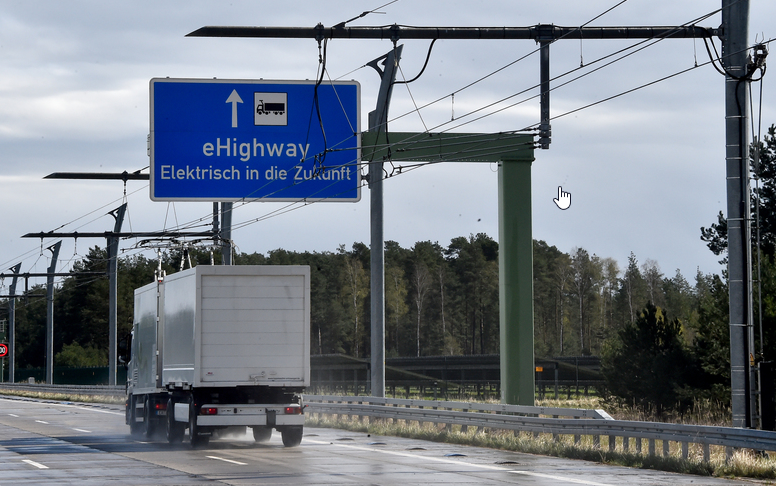
Similar tests are operating in the northern state of Schleswig-Holstein and the southern Baden-Württemberg, on the A1 and B462 motorways.
This is a prelude to original plans to electrify 4,000km of motorway in Germany, where long queues of diesel trucks in the slow lanes of highways are a common sight.
In total, trials with trolley trucks have so far cost the Germany €191 million (RM961mil). The Transport Ministry remains sceptical about the trials and has rejected any further financial participation, said the report.
A feasibility study for the ministry warned: If it were to be used nationwide, there would be an enormous demand for electricity at times of day when electricity is scarce anyway.
According to tech giant Siemens Mobility, when using the eHighway, "trucks can operate completely electrically and at the same time charge their batteries without using fuel." Several other countries, such as Britain, are experimenting with the technology.
Journalists from the Hessischer Rundfunk broadcaster initially requested files from state authorities, evaluated them and made their own enquiries, said the report.
Before results were foreseeable, the Hesse Ministry of Transport had said six years ago that the overhead trucks were "twice as efficient" as diesel. Today, there is only talk of "a possible building block" that overhead lines could represent for low-emission freight transport.
A surprising number of problems emerged, such as the frequent need to replace the insulators on the overhead masts. The transmission of data from the trucks for scientific evaluation also did not work reliably over long periods.
Maintenance was also time-consuming and trucks often run without overhead line current because the GPS navigation control is inaccurate.
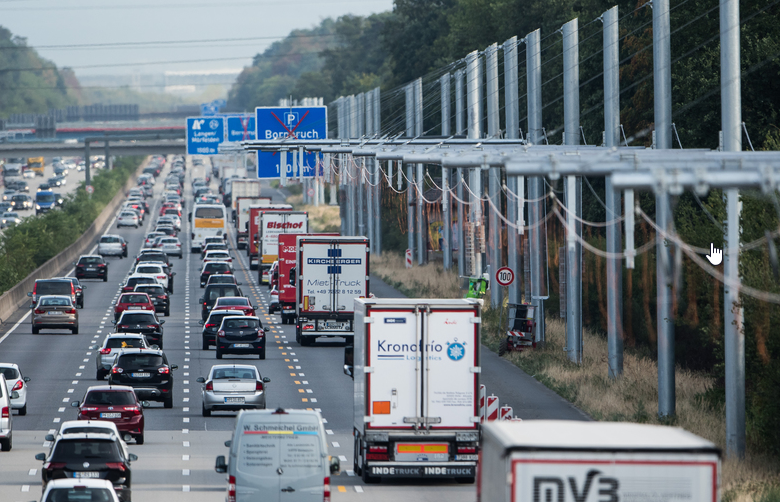
After a delayed extension of the test track, a lengthy acceptance procedure and, most recently, cable damage caused by an excavator, the power on the line near Frankfurt has been cut off in one direction since the beginning of the year and in the other direction since April.
While it is clear that overhead catenary lines to power trucks can, in principle, function properly, the ecological benefit is not clear.
The report gave the example of a trial truck operated by one haulage company which drove 50km a day to its destination along the A5 Autobahn using the full five electrified kilometres.
The cited researchers said the lorry emitted between 16 and 21% less greenhouse gases for the entire route. With stable operation and high usage, a maximum of 22% is possible, they estimated,
This only applies if carbon-neutral electricity is used and although power suppliers are contractually obliged to use renewable electricity, WDR said there was no evidence that they did so.