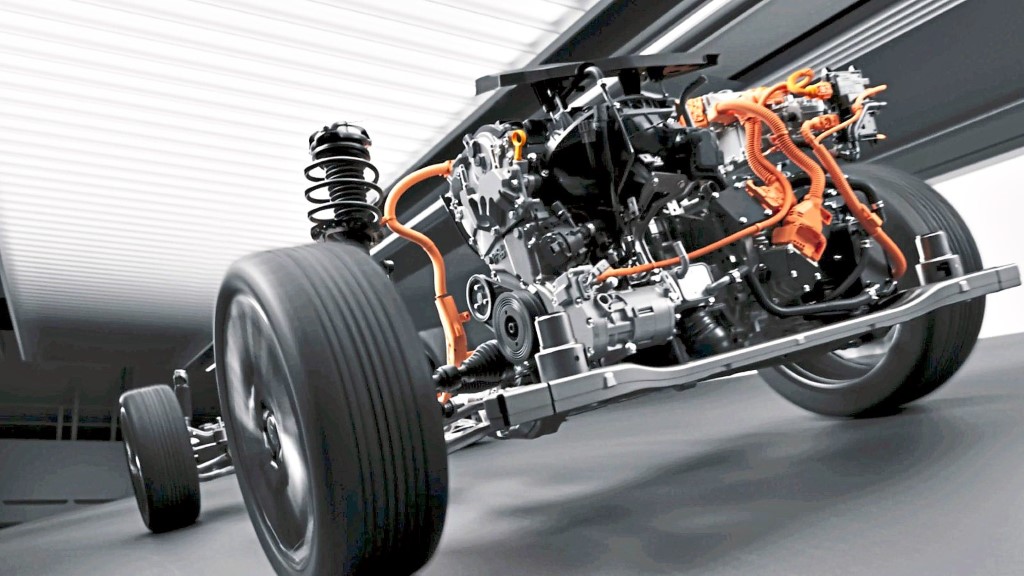
KIA Sales Malaysia will introduce the Turbo-Hybrid powertrain in its future models that promises more driving refinement and efficiency.
The technology combines a turbocharged petrol engine with an electric motor and hybrid system, with Kia placing emphasis not only on fuel efficiency but also on driving performance, smoothness and handling.
Kia Sales Malaysia managing director Emily Lek said the system was developed around three main areas – drive, experience and handling – bringing together power and efficiency, an engaging yet smooth driving experience, and sharp but steady handling.
“Other hybrids optimise how the vehicle uses energy. Our Kia Turbo-Hybrid also uses electric power to improve how the vehicle moves,” she said.
Lek added that the company wanted customers to understand the broader benefits of the technology rather than judge it solely by driving range or fuel consumption.
Kia Sales Malaysia product manager Faiz Bahruddin said the powertrain would be used in future Kia models.
“With Kia Turbo-Hybrid, the focus is still on drivability. It has to be able to drive well, offer smooth handling and a smooth feel, while being fuel-efficient at the same time,” he added.
The system is based on Kia’s next-generation Smartstream 1.6-litre T-GDI turbocharged petrol engine, which produces 180PS and 265Nm of torque and is paired with an electric motor producing 47.7kW for a combined system output of 235PS and 367Nm.
Energy is supplied by a 1.69kWh lithium-ion high-voltage battery, while power is transferred through a six-speed automatic transmission.
Unlike hybrid systems that use dedicated hybrid transmissions or continuously variable transmissions, Kia’s arrangement retains a conventional six-speed automatic gearbox.
Faiz said this was a deliberate decision to preserve the driving characteristics associated with a traditional automatic transmission.
“We have maintained a traditional six-speed automatic transmission for the sake of drivability, which allows for better engagement, better road feel and better performance as well,” he added.
The system uses a P2 electric motor integrated into the transmission housing, positioned between the engine and gearbox.
This arrangement allows the electric motor to provide drive assistance and regenerative braking while retaining the operation of a conventional stepped automatic transmission.
Another feature is Kia’s Continuously Variable Valve Duration (CVVD) technology, which adjusts how long the engine valves remain open – switching between Otto and Atkinson combustion cycles to suit different driving conditions and improve combustion efficiency.
The turbocharger also adjusts exhaust gas flow to reduce turbo lag at low engine speeds while maintaining pulling power when accelerating at higher speeds.
Faiz said the P2 arrangement also gives Kia flexibility in developing different drivetrain configurations.
“Because of our set-up, it allows for an actual mechanical all-wheel-drive system,” he said, referring to the use of mechanical linkages to drive the rear wheels rather than relying on an additional electric motor.
Depending on the vehicle application, the powertrain can be configured with either front-wheel drive or mechanical all-wheel drive.
Kia’s hybrid development dates back to 1995, when it introduced the KEV-4 concept at the Seoul Motor Show.
The Optima K5 became its first mainstream hybrid model in 2011, before the technology expanded into larger vehicles, including the Sorento sports utility vehicle in 2020.