GUANGZHOU: Chinese electric vehicle (EV) maker Xpeng has confirmed that its VLA 2.0 intelligent driving system will start deployment in 2027, with Volkswagen as the inaugural launch partner for the technology in the Chinese market.
Xpeng's robotaxi equipped with the VLA 2.0 has begun public road testing, and trial operations are scheduled to commence later this year.
As part of its global deployment, Xpeng will soon start international road testing.
Unlike traditional modular autonomous driving stacks, VLA 2.0 integrates perception, reasoning, and action within a unified AI (artificial intelligence) foundation model designed to improve cross-scenario generalisation while reducing reliance on high-definition maps and rigid rule-based systems.
Xpeng says the system interprets complex real-world environments and responds with driving behaviors that increasingly resemble those of experienced human drivers.
According to Xpeng, early testing has demonstrated robust performance in dense urban environments and mixed-traffic conditions.
The system is engineered to identify complex scenarios — such as erratic vehicles, accident scenes, and uneven road surfaces — and respond proactively.
"VLA 2.0 is the first version designed to achieve full autonomous driving and will iterate at an unprecedented pace. We believe that full autonomy will arrive within the next one to three years, making autonomous driving a natural part of people's daily travel," said Xpeng chairman and CEO He Xiaopeng during the company's recent “The Future” VLA Media Experience Day.
Xpeng's VLA 2.0 can cover campus lanes, rural dirt roads, and non-navigable routes, and handle complex conditions such as narrow lane passage and potholes avoidance.
The system also supports starting from a standstill, delivering a "full-process assisted driving" experience.
It is also said to improve driving efficiency by 23%.
In measured tests during Guangzhou’s evening rush hour, its traffic efficiency exceeded that of traditional L2 intelligent driving systems and robotaxi models, achieving performance comparable to experienced human drivers.
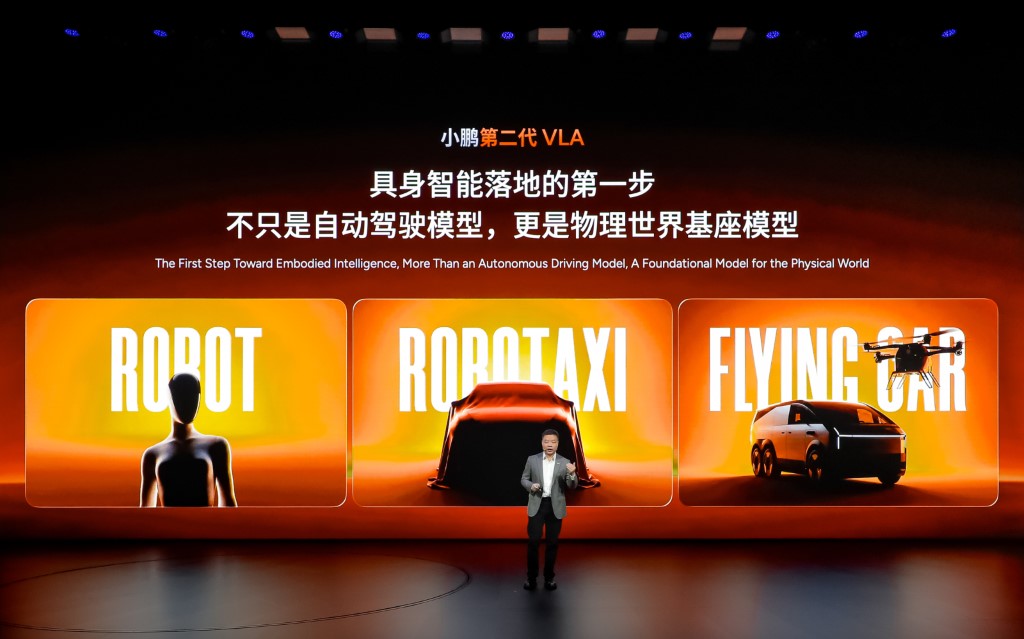
Xpeng also stated that the AI foundation model behind VLA 2.0 is designed to extend beyond passenger vehicles.
The same underlying architecture is being applied across multiple embodied AI platforms, including robotaxi fleets, humanoid robots and modular flying vehicle systems.